
Dam Catfish is a figure of Alabama folklore.
Where it is told
Field Guide
The Dam Catfish: A Field Guide to the Big Fish Under Alabama's Dams
Wherever a river in Alabama was backed up behind concrete, divers and anglers say something enormous settled in at the foot of it.
1 A Diver at Lake Martin, Dadeville
Wendell Pruitt has sold minnows and crickets at a landing outside Dadeville for thirty years, and he tells this one with a cricket box in his lap. The bait shop smells of wet rope and diesel, and the lake slaps the pilings behind him while he talks.
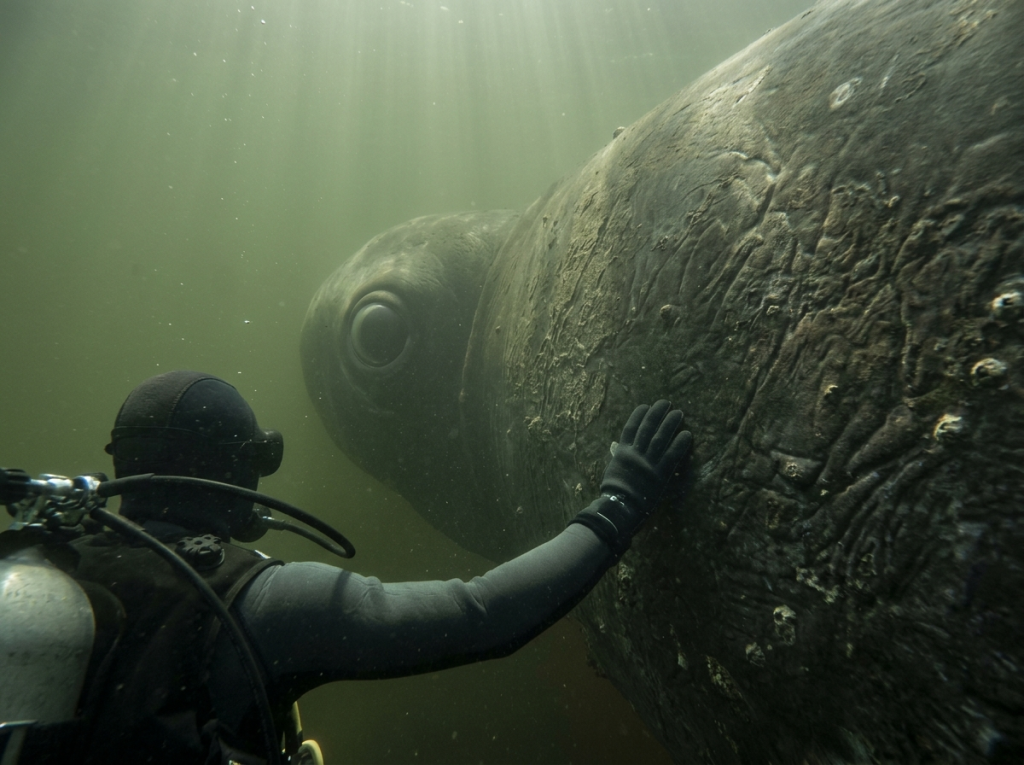
"Fellow went down, I couldn't tell you when. I couldn't tell you where on the lake, either. Just the bottom, off Dadeville, and dark."
He holds up a hand flat, like a man feeling for a light switch.
"He bumps into it. Long, and solid, and he figures it's a tanker truck. So he swims along it, all the way down the length of it. Up front there's a fitting, a round thing sticking out like a tank would have."
Wendell stops and lets the pilings slap twice.
"Only it ain't a fitting. It's an eye. And the eye's on a catfish as long as that truck."
He shuts the cricket box. Ask him what the diver did next and he shrugs. The story doesn't say, and he won't make something up.
2 What They Call It
It has no proper name. It is the big catfish, or the dam catfish, and anglers say it came up from the divers. The name hangs on a place more than on an animal. You hear "the one below Wilson Dam," the way you would name a mule by whose barn it stands in.
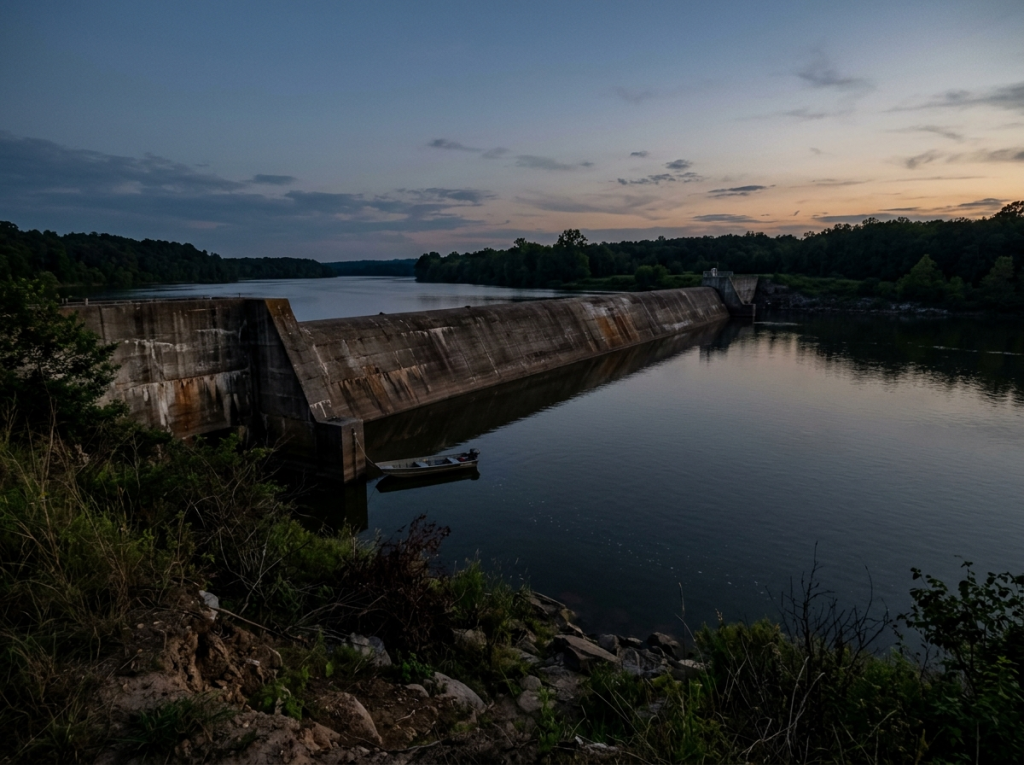
The size changes from river to river. On the Tennessee it is as big as a car. On the Coosa at H. Neely Henry Dam, near Ohatchee, it was first described as big as a man, and in time as big as a Volkswagen. At Smith Lake it is a man again, and at Lake Martin it is a tanker truck.
Zeb Hogan, a fish biologist, says scuba divers and fishermen tell this tale at nearly every dam. The Lake Martin story comes from a 2012 blog post that collected giant-catfish tales. That post admits the same diver story gets told about almost any local dam.
3 How Witnesses Describe It
Witnesses give size, and little else.
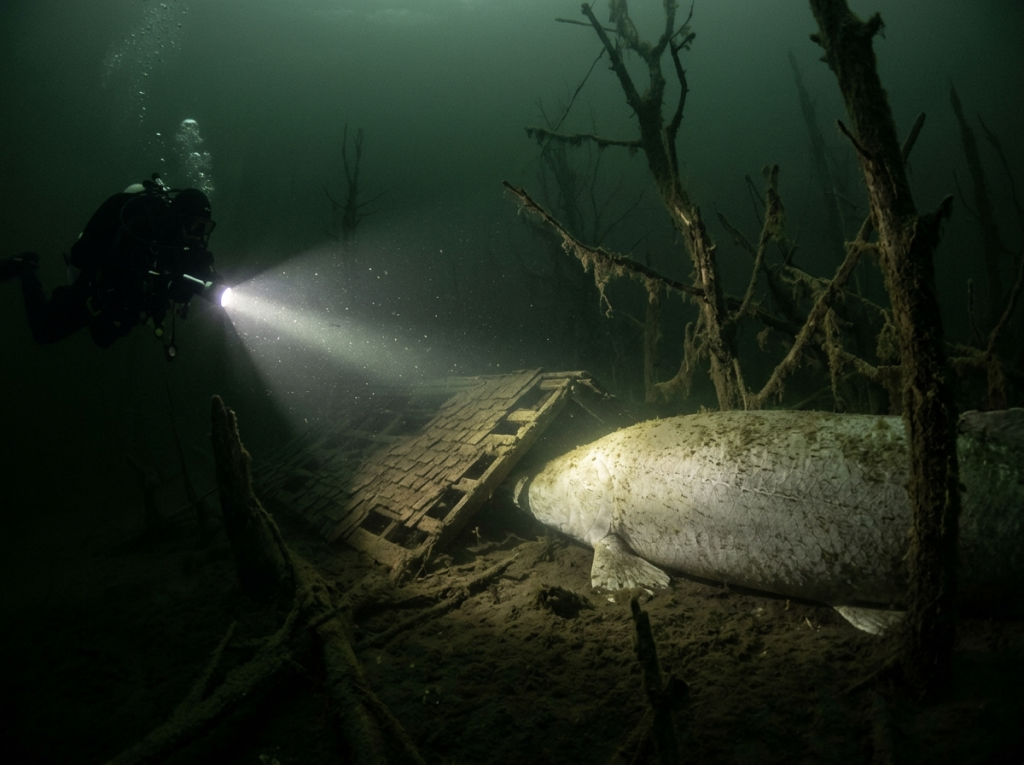
At Wilson Dam in Muscle Shoals, the divers inspecting the dam said the fish were as big as cars, resting on the bottom. Resting. Nothing was chasing anybody. At Ohatchee the Neely Henry divers came up and said catfish as big as a man lurked in the deep water by the dam structure. At Smith Dam the fish are as big as men in the deep water near the dam. The talk puts them alongside barns, cars and trees said to stand drowned beneath the surface, because the lake was filled over farms, roads and homesites in Walker, Winston and Cullman counties.
The Lake Martin diver gives the least. He has the fish's length and its eye, and no head, no mouth, no colour. He has a long flank beside him and an eye the size of a fitting.
4 Where It Turns Up
The Tennessee River stories run from Wilson Dam at Muscle Shoals, in Colbert County, upriver to Guntersville Dam in Marshall County. Anglers up and down that stretch swap the same tale about car-sized fish at the foot of the TVA dams. The Coosa version sits below H. Neely Henry Dam at Ohatchee in Calhoun County. Smith Lake lies in Walker County near Jasper, and Lake Martin is down in Tallapoosa County around Dadeville.
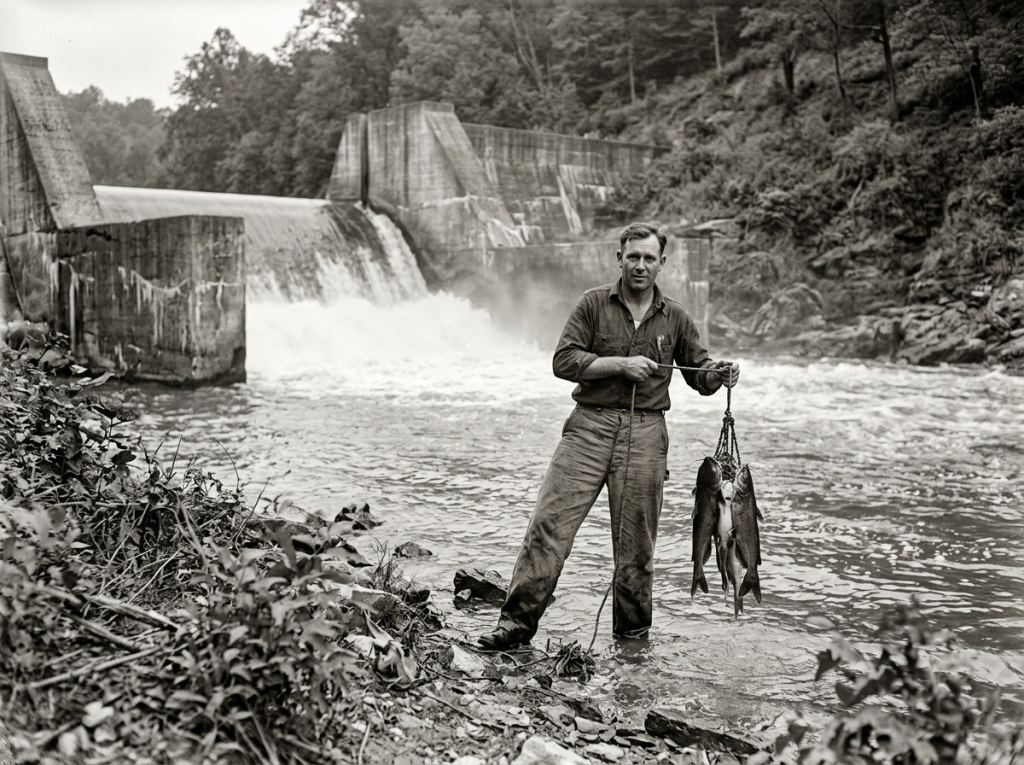
Guntersville has a date to hang on. A 1939 Alabama Archives photograph shows a man with a string of catfish, the biggest at 67 pounds, taken at Shoal Creek below the dam on September 21 of that year. The Coosa was dammed in the late 1950s and the 1960s, and the Ohatchee dam was finished in 1966. Smith Lake was filled in the late 1950s. The Coosa and Smith Lake tellings both come from those years, when the water first went still behind new concrete.
5 Behaviour and Its Effect
The fish rests on the bottom against the structure, and the only thing the tellings have it do to a person is be seen. The Wilson Dam divers who saw car-sized fish refused to go back down. That is as far as it goes. No boat is rammed in any telling, and no line is bitten through.

What does happen is the growing. The Ohatchee divers reported a man-sized fish. Over the following decades locals worked it up to a Volkswagen. No catfish of that size has ever been recorded.
The real fish do their part. Blue catfish of 50 to 80 pounds are common on Wilson Lake. In March 2020 a guide from Russellville, Mike Mitchell, caught and released one of 117 pounds, only a few pounds short of the state record. Guntersville has given up blues of 84 and 102 pounds. A University of North Alabama write-up on Wilson Lake says most of the dam's myths involve its catfish, and the sizes are often exaggerated. The real fish are big enough to keep the story alive.
6 Telling It from Other Things
The diver mistakes the fish for machinery. At Lake Martin he took it for a sunken tanker truck, with the right length, the right bulk and a fitting where the eye was. At Wilson Dam they went with cars. Down in Smith Lake there are barns, cars and trees to confuse it with, all said to be standing on the bottom. A big shape lying still in dark water makes a poor candidate for a fish, until the fitting turns out to be an eye.
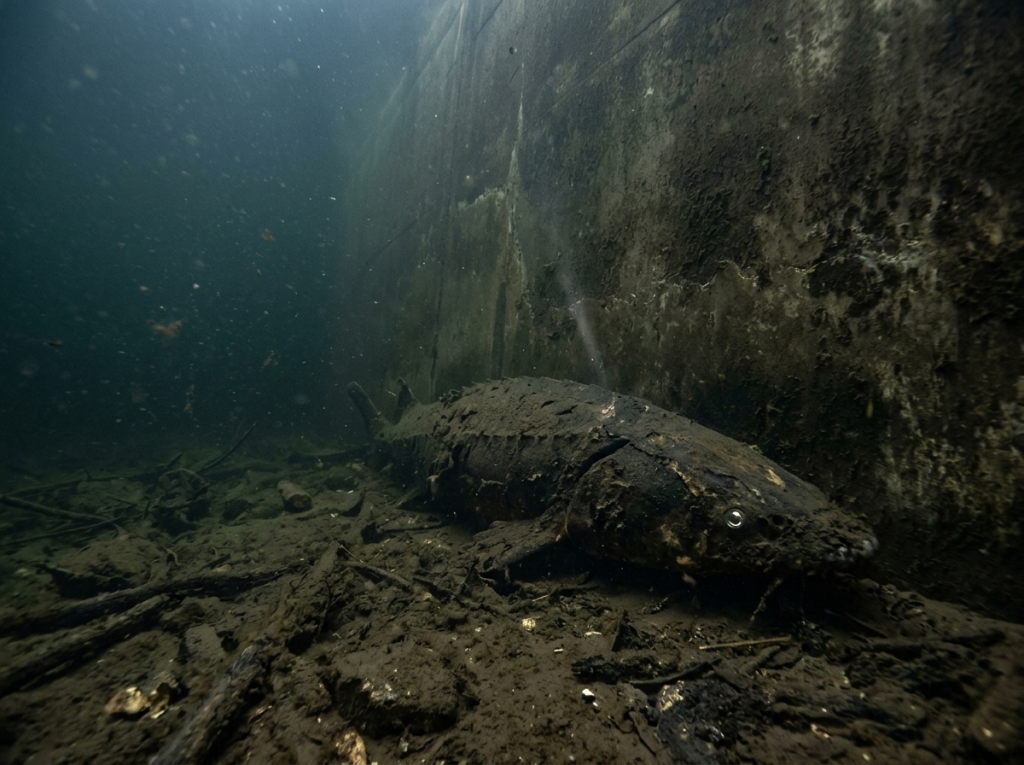
The second mix-up comes from the biggest real fish. A 117-pound blue cat is a sight, and whoever lands one will tell you it is the most fish he ever met. Set that beside a fish as big as a man and the gap is plain. None of the tellings has anyone landing a dam catfish. It stays down against the structure, and the only people who report it are the ones who went where the light stops.
7 How the Legends Fit Together
Lay the tellings side by side and the same pieces keep turning up. There is a diver at the foot of a dam, a fish resting on the bottom, and a size too big to be true. Wilson Dam and Guntersville Dam sit at either end of the Tennessee stretch and tell it nearly the same way, car-sized fish and all. The Coosa tellings start with a man-sized fish at Ohatchee and let it swell to a Volkswagen. Danny Crownover, a writer in Gadsden, links the Ohatchee tales to the older Coosa serpent sightings and to reports of alligators killed on the river around 1900.
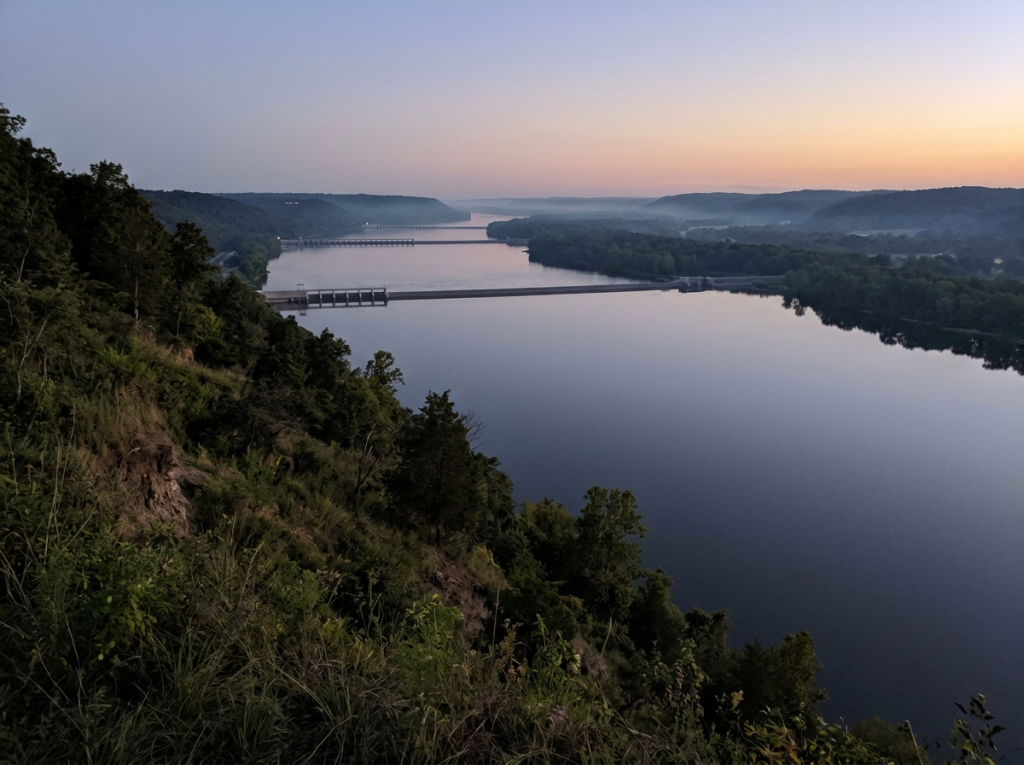
Smith Lake has the same man-sized fish, with the drowned farms under it. Lake Martin has the diver with a flank beside him and an eye at the end of it. Every one of them puts the fish where the river was stopped, and every one has a diver who came back up with a size.
Sources
Field Guide is drawn from the legends as they are recorded. Its first-hand account is imagined. Its pictures are imagined scenes.