
Noccalula is a figure of Alabama folklore.
Where it is told
Field Guide
Noccalula, Who Gave the Falls Her Name
A chief's daughter, a promise made over goods, and ninety feet of Black Creek water at the edge of Gadsden.
How to know it
- Name
- Noccalula, said to be the daughter of a Cherokee chief.
- Size
- Nobody gives her a height or a build; the only measurement is the falls she leapt from, ninety feet.
- Where
- The waterfall on Black Creek at Gadsden, in Etowah County.
- When
- Her story has been told in Gadsden since at least the 1890s, and it is set well before that.
- Habits
- She refuses a match arranged for her and goes to the edge of the falls rather than accept it.
- Kin
- A father who is a chief and who bargained her away for goods.
- Sweetheart
- A young man of her own people.
- Intended
- A wealthy chief from another tribe, or in some versions a European trader.
- Mistaken for
- Her own bronze likeness, which stands at the falls in the city park.
- Variation
- Most say Cherokee; some make her Creek.
1 At the Rail Above Black Creek, Gadsden
I worked the grounds at the park above the falls for thirty-one years. Every spring a school bus would pull in around nine, and I'd walk the kids out to the rail and tell them what my grandmother told me.
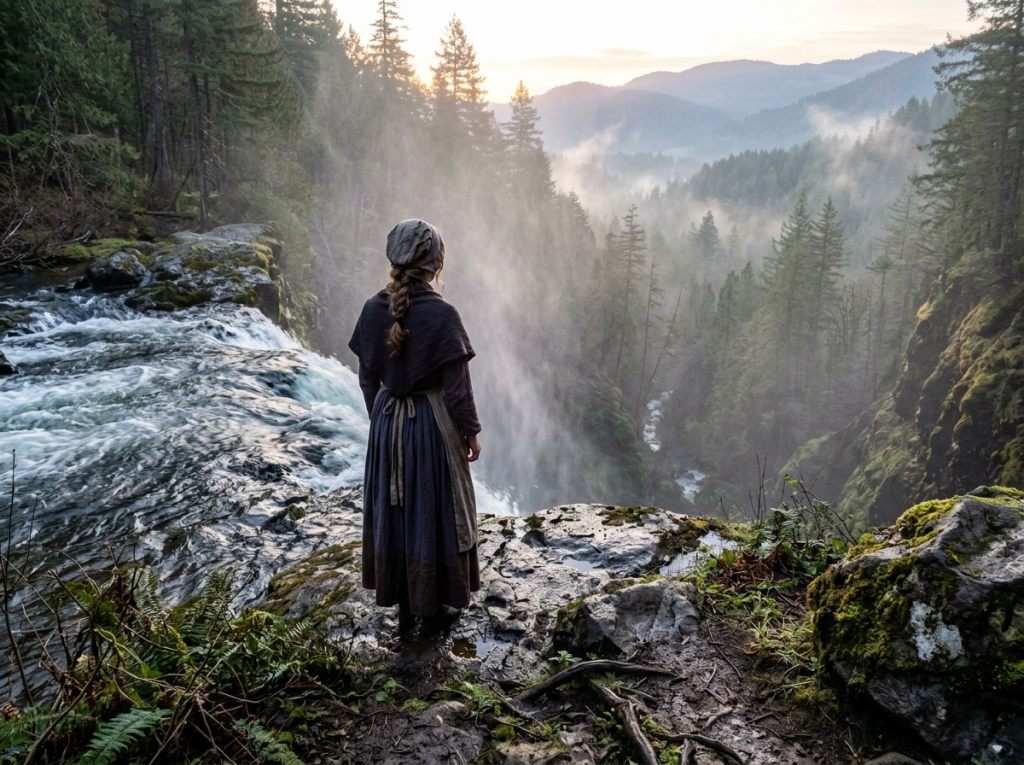
You go past the statue and you hear Black Creek before you see where it quits. The creek runs along like any creek in Etowah County, brown over the rocks, and then the ground ends and the water drops ninety feet in one piece. I have stood there at six in the morning with the mist coming up and the mower idling behind me, and the only things I ever saw at that edge were visitors and a heron. What I saw every season was people going quiet at the rail.
The way my grandmother gave it, Noccalula was a chief's daughter, and she loved a young man of her own people. Her father had promised her to a wealthy chief from another tribe, and the promise was made in return for goods. She walked to the lip of the falls instead and jumped. Her father called the place by her name afterward, and that is what it has been called ever since.
One boy in a red jacket asked me last April if it was true. I told him it has been told at that rail since before I was born, and that nobody has ever proved it. He looked over the edge a good while. Then I sent them all back to the bus.
2 What She Is Called
My grandmother said the name slow, all four syllables, like she was setting it down on the table. Noccalula. In Gadsden it belongs to the girl and to the falls both, and nobody I knew ever tried to pull the two apart.
She was a chief's daughter. My grandmother never wavered on that. Her father was a chief, the young man was of her own people, and the one who bought her was a wealthy chief from another tribe. None of the men ever got a name from my grandmother. She'd say "the chief" and "the boy" and "the other one," and leave it there.
The part that shifts is the nation. Most folks I've heard make her Cherokee, with a Cherokee chief for a father. A few make her Creek, and then the man she was promised to turns into a European trader. I had a fellow from out of town stand at the rail and tell it that way, and I let him finish. Same father, same goods, same girl who wouldn't go.
3 What Folks Say She Looked Like
My grandmother never said what Noccalula looked like, and I never thought to ask until I was grown. By then I'd heard the story told a dozen ways at that rail, and not one teller gave her a height, or a color of hair, or a dress. She was a girl who loved a young man, and that was what got handed down.
The place is what stays put. Ninety feet is the number. I never heard anybody say eighty or a hundred. It is Black Creek, it is Gadsden, and she is at the lip with the water falling away below her.
The only face she has is the bronze one standing in the park. Kids ask me if that's what she really looked like, and I tell them it's what the town decided to put up. Then they go and stand beside it for a picture, and I let them.
4 Where and When She Turns Up
Mostly she turns up right where I worked. One county, Etowah. One town, Gadsden. One spot, the falls on Black Creek. I never heard her put anywhere else, and if you want her, you walk out to the rail.
As for when, my grandmother only ever said "a long time back," back when a chief could trade a daughter for goods. Folks in Gadsden were telling it by the 1890s at least, and they told it like something already old.
I'll say plainly what the historians say. No record backs it up, and some of them figure it was made up. I told that to the boy in the red jacket and I've told it to plenty of grown people. Not one of them turned around and left the rail.
5 What She Does
What she does fits in a few breaths. She loves a young man. Her father promises her away for goods. She won't have it, and she goes to the edge of the falls and leaps.
Then comes the part my grandmother slowed down for. Her father grieves, and he gives the falls her name. She didn't say he wept or raged. She said he named it, and she let that be enough.
I used to stop talking right there when the school groups came. The water was loud behind us, and the kids would lean out over the rail a little, and nobody needed me to say more. The bus driver would be leaning on the fender, waiting, and he'd stop looking at his watch.
6 Telling Her Apart
People get a few things crossed, and I've corrected most of them at one time or another.
Some think the statue is the legend. It's a bronze, and it came along well after the telling. I've watched visitors walk up the footpath in the early light and slow down when they catch sight of it, and I couldn't blame them.
Some argue over the nation, Cherokee against Creek. I never took a side. A man who says Creek and a man who says Cherokee are carrying the same bargain, and the girl ends up at the same edge either way.
And some figure the waterfall is what the story is about. My grandmother would have told them different. The falls are where it happened, and the girl is who it happened to.
7 How the Pieces Fit
I retired a few years back, and I still drive out some mornings, park by the statue, and walk to the rail with my coffee. The creek is brown over the rocks and then it is gone, ninety feet down, the way it was when I was a boy and my grandmother held my hand a little too tight at the edge.

I still think about the father more than I used to. He made a promise for goods, and his daughter walked out ahead of him, and all he had left to give her was the name. I don't know if any of it happened. I know what it sounds like when a bus full of kids goes quiet over that drop.
The heron is usually there, down on the rocks. Some days it lifts off while I stand at the rail, and I watch it go down the creek until the trees close over it.
Sources
Field Guide is drawn from the legends as they are recorded. Its first-hand account is imagined. Its pictures are imagined scenes.