
The Lost Regiment is a figure of Alabama folklore.
Where it is told
Field Guide
The Lost Regiment of Lookout Mountain
A body of Union soldiers wandered off a skirmish near Adamsburg, never found their way out, and by local account are still walking.
How to know it
- Name
- The Lost Regiment, a body of Union soldiers from the Civil War.
- Size
- A regiment's worth of men at the start, and no telling gives a count of how many walked off.
- Where
- The rugged woods of Lookout Mountain, from the skirmish ground near Adamsburg in DeKalb County to the mountain near Blanche in Cherokee County.
- When
- The Civil War is when they were lost, and the walking is told as going on yet.
- Origin
- A skirmish near Adamsburg, after which the soldiers could not find their way out of the woods.
- Last seen
- The last survivor was said to have been seen near the Blanche community.
- Tracks
- A line of bootprints in fresh snow that simply stops.
- Movement
- Walking, as men do who are still looking for a road.
- Habits
- Locals say the regiment still walks the mountain, and nothing is told of it reaching anyone or anywhere.
- Mistaken for
- Nothing is recorded, but the one sign left is a line of bootprints in snow.
1 Above Blanche, Cherokee County
My granddaddy had a place on the side of that mountain above Blanche, and I was born in the house he built. I was thirteen the winter it snowed the night before a school day, which in that part of Alabama counts as an act of God. I went out before light to see to the stock and there it lay, a good three inches, clean as a sheet on a line.

I went up the slope behind the barn because a boy will do that with fresh snow. About a hundred yards up, I came on prints. They were boot prints, a man's boot or a few men's, one behind the other in a single line, the way people walk when somebody ahead is breaking the way. Nobody had told me then what was up there. I thought it was a hunter, and I was a little put out that somebody had beaten me to the snow.
I followed them. They did not wander. They went along the slope like a man who knew where the next step was, and I will admit I felt easier for it. A hunter with a plan is a comfortable thing to follow.
Then they stopped. I do not mean the man turned and went back, or stepped off to the side. The last print was as sharp as the first, and past it was snow with nothing in it. I walked a circle around that spot, and then a wider one. I looked up into the trees as a boy does, which is foolish, since I was looking for a man who had left no mark going up or down.
I went home and told my granddaddy. He did not laugh. He set his coffee down and asked me how many were in the line. I said I could not tell him, because they were all stepped in on top of one another. He nodded and said that was how they went. That was all he said, and he would not say more until he had finished his coffee, and by then I had lost my nerve to ask.
I have been told since where those prints come from. I do not say they came from there, and I do not say they did not. I only say I walked that line to the end, and the end was in the middle of a clean white slope.
2 What the Mountain Calls Them
They are the Lost Regiment, and nobody on Lookout Mountain has ever tried to improve on the name. You will not get a number for them or a colonel. Ask around and you get the same three things. They were Union soldiers. There was a skirmish near Adamsburg in DeKalb County. Afterward they could not find their way out of the woods.
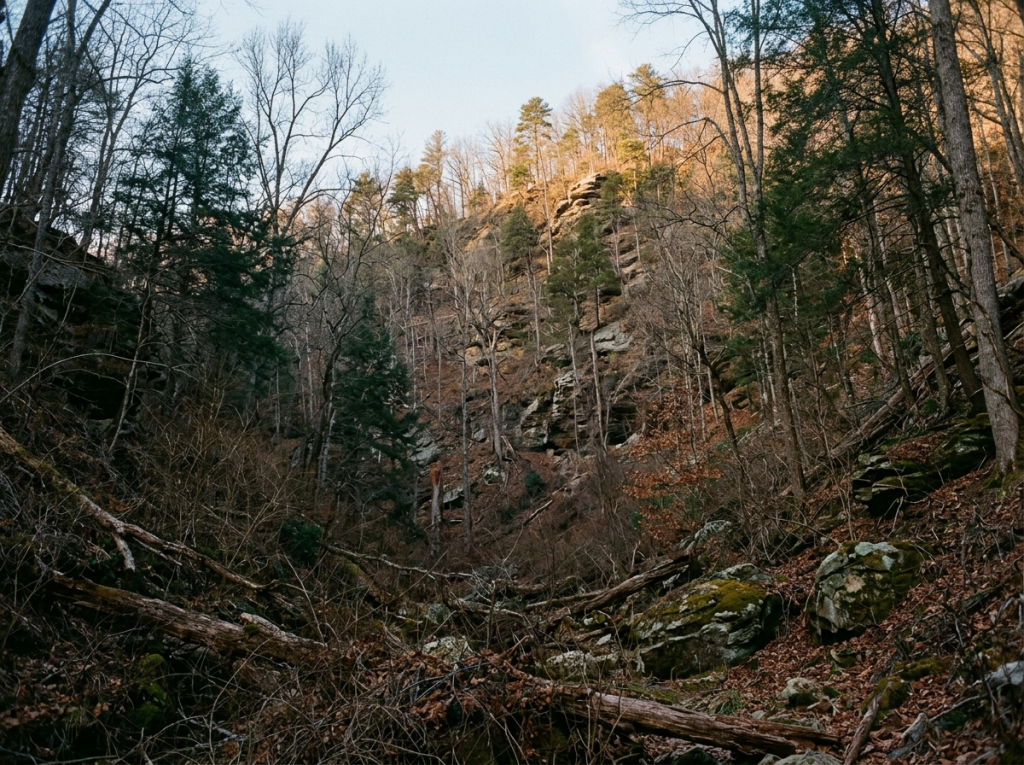
The mountain runs long and broken from one county into the next, and the ground near Adamsburg is a hard walk from the ground near Blanche in Cherokee County. The soldiers are carried the whole way. Wary locals and Confederate troops picked some of them off as they wandered, and the rough country took others, until one man was left. He was seen near Blanche.
At the store they will tell you that regiment is a big word for what was left of them by then. A regiment has orders and a road. These men lost the road the day of the skirmish, and in all the years since, nobody has handed it back.
3 How They Are Described
I asked at the store in Blanche once what the Lost Regiment looked like, and nobody mentioned a face. Nobody mentioned a uniform beyond the word Union, or a voice, or a lantern. Mostly they talked about the boots.

The prints come in fresh snow, in a line, one behind another. An old man by the stove told me the line was the whole of it. A fellow buying feed said it was poor proof, since snow shows you whatever you carried up the hill. The third just said he went up the next morning, and the cold got through his gloves, and he came back down without saying much.
What none of them argued about was the end. The last print is as crisp as the first. There is no road past it, no door, no fence, only smooth snow and the trees standing around in the gray light. All three of them had stood there, and none of them wanted to stand there long.
4 Where and When It Turns Up
It is not a big piece of country. The skirmish was near Adamsburg, in DeKalb County. The soldiers were lost in the woods of Lookout Mountain. The last survivor was said to have been seen near the Blanche community in Cherokee County, and the tale is set on the mountain there. No single spot is named. Ask for the exact hollow and somebody will point you to three.

Go from Adamsburg to Blanche and you have covered the whole of it. If the regiment still walks, as locals say, it walks between those two places, and Blanche is where the walking gets noticed.
The war is the age they were lost in. The sign comes in snow, because snow is what holds a line of prints well enough to show it. On a January morning up there the ridge goes gray, and the woodsmoke from the chimneys lies low in the hollows, and the cold gets into your teeth. Nobody I know says they walk only in winter. They only say that snow is when somebody sees it.
5 What They Do and Don't Do
Nothing in the telling has them reach anybody. No calf is taken, no mule frightened, and nobody wakes to a face at the window. What is told is what was done to them. Locals and Confederate troops picked some of them off as they wandered, and the harsh terrain claimed the others but one.
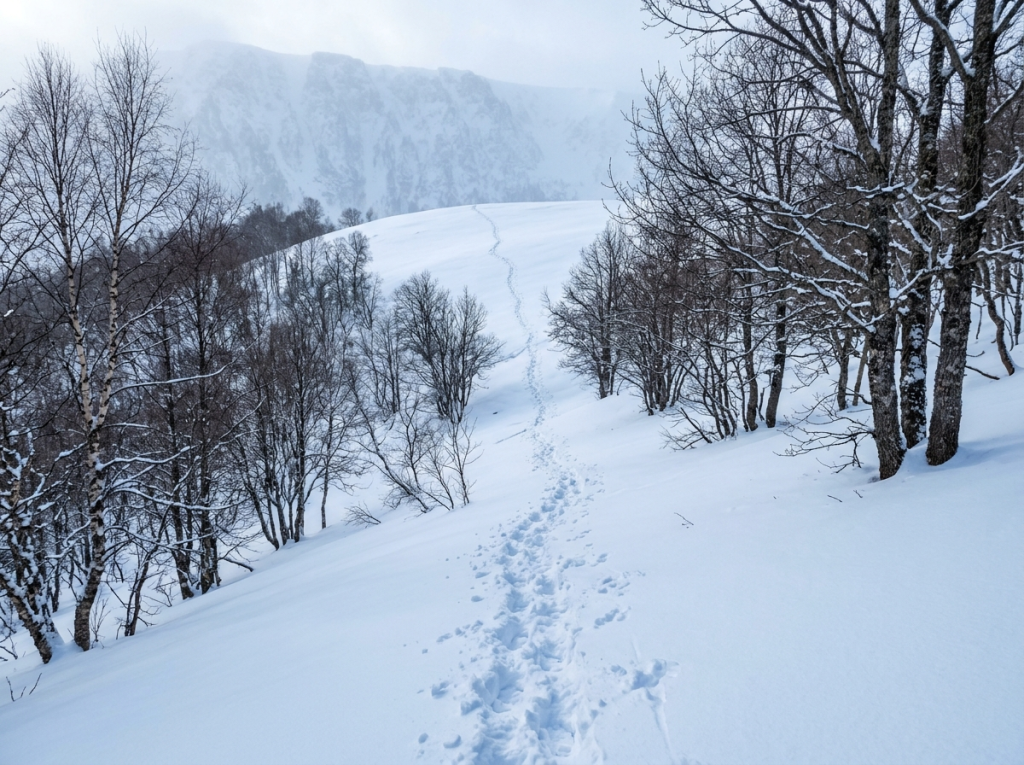
What they do is walk. They are said to be walking still, and the one mark of it is a line in the snow. The man who finds it gets the line and nothing more. Some who found it went home and said little for a week. Others went back up at first light to look again, and found the line just as it was, with the snow undisturbed on either side.
A neighbor of ours told me his hound would go up that slope all day after a coon, but that morning it stopped at the first print and sat down in the snow. He said it whined, and he had to carry it back. Nobody says the soldiers are angry, and nobody says they are hunting anyone. They are trying to get out of the woods, and so far as anyone tells, they have not.
6 Telling It from Something Else
Nothing is recorded as being mistaken for the Lost Regiment, which does not stop the arguing. A hunter will tell you it was just a man out after deer, and the wind covered his trail. Another will say a hunter's line goes somewhere. It leads to a stand or a truck or a cabin, or it turns back on itself. This one did none of that. It went along the mountain and stopped with nothing past it.

A deer's split hoof is not a boot, and nobody who has stood over these prints says otherwise. What they describe has a heel and a sole, and a man can read that for himself in the snow. The harder thing to read is the count. When the prints lie one stepped on top of another, you cannot say whether it was one man with a long stride or a file of them, and I could not say as a boy.
Nobody I have asked since could tell me either. The only count I have is a boy's, from a barnyard at dawn, with cold hands.
7 Why the Story Holds Together
There is one legend here, the Lost Regiment of Lookout Mountain. It ties the skirmish ground near Adamsburg to the hills above Blanche, and DeKalb County to Cherokee County along one long mountain. It ties a war that ended generations back to a boy in a barnyard at dawn, with snow melting into his boots.

The telling goes fight, wandering, last man, prints in the snow. Follow it down the mountain the way the regiment is said to have gone, and at the end you find what they found, which is more woods and no road. If you go up some morning after a snow, look at the ground before you look at the trees. When the line quits, stand on the last print. I did, and I never heard anything but my own breathing.
Sources
Field Guide is drawn from the legends as they are recorded. Its first-hand account is imagined. Its pictures are imagined scenes.