
Granny Dollar is a figure of Alabama folklore.
Where it is told
Field Guide
Granny Dollar of DeSoto Falls
An old woman and her dog walk the woods near DeSoto Falls, and the people of Mentone have a good idea why.
1 Dusk at DeSoto Falls
I'll tell this the way a man I knew told it, since he was the one who saw it. He grew up on the Mentone side of the mountain and worked most of his life driving a feed truck around DeKalb County. By his own account he was not a man who saw things.
He was a boy of about twelve, sent down toward DeSoto Falls to bring back a cow that had gone through a fence. The light was going. He walked the edge of the woods because the cow liked the shade. He was thinking about supper and not much else.
Ahead of him, along the tree line, somebody was walking a dog. An old woman, he said, and he never said more about her than that. He noticed the dog first, the way it kept to her side and kept its attention on her instead of on him. He had grown up around dogs. A dog that is looking at you and a dog that is looking after somebody are different animals, and this one was looking after her.
He took her for a neighbor and thought about calling out. Then he thought about how far he was from any house, and he could not think who in Mentone would be walking out here at that hour. He stayed quiet. She went on along the woods, and the dog went on with her.
He said he did not run. He turned and walked back the way he had come, at an ordinary pace, and the cow found its own way home. Nobody at supper asked what kept him. Years later he heard the old story about Granny Dollar and her dog, and he put his fork down. He never said he had seen her. He only said he knew what the dog had looked like.
2 What She Is Called
In the stories she is Granny Dollar. On the church rolls and the paper she signed, she was Nancy Callahan Dollar. Granny is what a Southern town calls an old woman once it has quit counting her years, and Nancy Dollar had been called it so long that most people forgot there was another name. She died in 1931, and right up to the end she said she was over a hundred.
Nobody can check a hundred years against a birth record now. The people who told it never tried. A woman who says she is past a hundred and lives alone in a cabin by the woods gets believed by her neighbors, or she gets left alone, and out there it came to the same thing.
She was Cherokee. The tellings say so plainly. Her cabin stood near what is now the north entrance of DeSoto State Park, and she lived in it by herself, with a dog.
The dog was Buster. He turns up in the same breath as her every time, and the longest version of the legend carries his name right in the title: Granny Dollar and Her Dog Buster. Tell it at a porch rail in Mentone and somebody will bring up the dog before you get to the end of the first sentence.
3 What Witnesses Describe
People ask what she looks like. I tell them what I was told, which is an old woman and a dog. She is walking. The dog is with her. They are by the woods near DeSoto Falls, and that is the whole picture.
The dog gets the most said about him, and what gets said is that he was fiercely loyal. That tells you more than a coat color would. Anybody who has kept a dog like that knows how he stands when his person is near, a little forward of her, never far.
So the feeling a witness takes home is of having come across a pair. You are at the edge of the woods in poor light, and a woman is out with her dog, and you think nothing of it for a few steps. Then you start working out where she could have come from, and what an old woman was doing out there with no house in sight.
Some say Buster still roams there. In those tellings he gets his own life. A dog on the move at the edge of the trees, nosing along, and the woman somewhere behind him. A loyal dog stays near his woman. If you see him, you know she is close.
4 Where and When
The ground is small, and the stories stay inside it. DeSoto Falls is in DeKalb County, and the woods around it are where the old woman is seen. Her cabin stood near the north entrance of what is now DeSoto State Park. The park grew up around country she walked every day, and the people who run it tell their visitors about the waterfall, not about her.
Her grave is in Mentone, in the same county, a few miles of mountain road from the falls. Anyone from around there can hold both places in their head without a map.
The time is particular too. The sightings belong to the years her grave went unmarked, and those years ran to decades. Nancy Dollar had set money aside for a tombstone. It was stolen. The stone she meant to have never came, and for a long stretch nothing stood over her to say whose grave it was. A small town does not forget a thing like that. Neighbors who had known her kept pointing to the bare ground and telling the young ones whose it was.
The falls area is in a public state park, and people go there as they go to any park. Her former cabin site is another matter. It is not a visitor attraction, and nobody should go looking for it as one.
5 How She Behaves
She walks. That is the center of every telling. She goes along the edge of the woods with the dog beside her, at the pace of somebody who has made the trip ten thousand times, and then she is past.
An old woman living alone with a dog would have walked him every day of her life, along the same trees, in all weather, whether anyone saw her or not. A cabin by the falls in 1931 had no neighbor close enough to wave to. The dog was company, and the walk was the day's one outing. The sightings give her the same habit afterward.
You can tell her from an ordinary walker by where you are. A woman and a dog on a road near town are a woman and a dog. A woman and a dog at the edge of the woods by the falls, near no house, with nobody around who could have asked her out, are what people in Mentone mean when they say Granny Dollar.
I asked the man with the feed truck whether it frightened him. He thought about it and said no, it was the most ordinary thing he ever saw. Then he said he had never been able to forget it.
6 How the Story Holds Together
Her story goes in order. A woman lived alone by the woods with her dog. She died in 1931, and her grave in Mentone went unmarked for decades because the tombstone money was stolen. In those decades people saw an old woman walking a dog near DeSoto Falls. Some say the dog is still there.
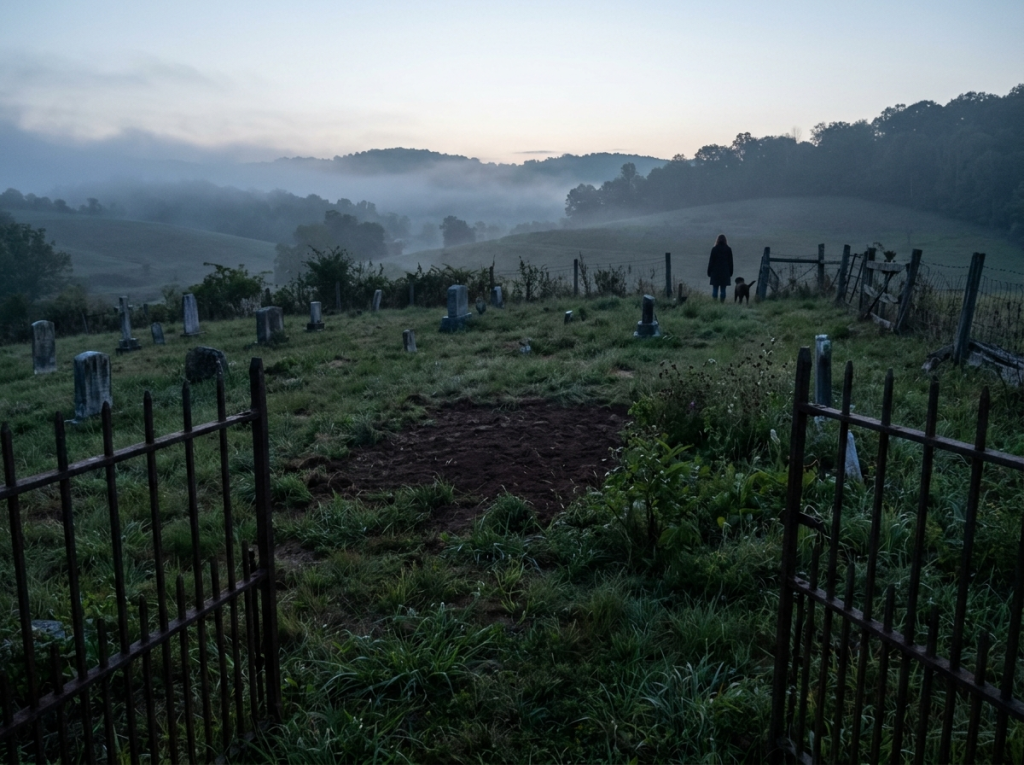
Each piece leans on the next. The theft leaves the grave without a name, and the grave without a name leaves a woman who keeps walking. The dog is the part that carries over, because a dog does not forget where his person goes.
A grave with nothing on it bothers people in a small town. Somebody took an old woman's tombstone money, and Mentone has told it ever since, from porch to porch and parents to children. Every telling leaves her out there with her dog.
Go to the falls and walk the park paths as anyone may. Watch the tree line if you like. If an old woman comes along it with a dog at her side, step off the path and let them pass.
Sources
Field Guide is drawn from the legends as they are recorded. Its first-hand account is imagined. Its pictures are imagined scenes.